Showing posts with label Ambrose Chronicles. Show all posts

Friday, October 24, 2014

Friday Food for Thought #25

Ambrose Chronicles: Midshipmen - Designing the UES Swift Fox - Part 2

Well I said I'd spend some time talking about hull design and power systems. So here we go.

Hull Design:

The UES Swift Fox uses a carbon-carbon composite hull.  Essentially it's an advanced form of carbon-fiber composite, treated to be heat and radiation resistant.  I'm not the best at engineering math, but I've given the hull material a couple estimated properties.

Density of 3.52g/cm3
Melting Point of 3,500 degrees Celsius
Stuctural Strength of 1,350 MPa (megapascals)

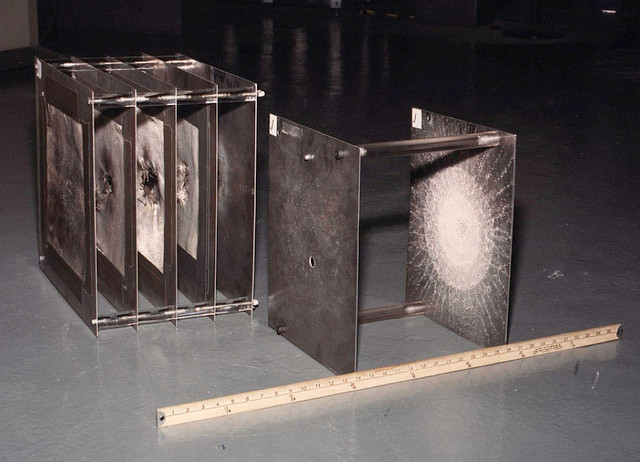
The main hull is protected by what is known as a 'Whipple Shield' composed of layers of spaced armor.  This type of protection is already in us on modern spacecraft.


Spaced armor is a relatively old concept, but it's a good one so I decided to incorporate it.  I've also decided that since I intend to make the ship atmospherically capable, the ship would need a form of heat shielding.

Overall the shape is going to be kind of similar to that of the Dominion Dreadnaught from Star Trek Deep Space, but much smaller.

The underside of the ship will be rather rough and utilitarian.  Radiator panels are arrayed along the underside of the ship's 'wings' so that they can be protected from fire by rolling the ship so it's top surfaces face the enemy.  In addition the top surfaces are the only ones with heat shielding, necessitating that the ship reenter upside down.

Power Systems:


Both the Swift Fox's power systems and propulsion are antimatter systems, specifically anti-hydrogen reaction systems.  The engines use small amounts of anti-hydrogen atoms reacting with deuterium or water to produce a magnetically directed beam of superheated plasma for thrust.  In atmosphere this beam is almost instantly diffused, but in space it's capable of being used as a weapon at extremely short ranges.

Power is independently generated from the engines, as power is considered a separate system then thrust.  The ship's main power comes from a 2.75µg/s White-Rinmukan AM-M Reactor.  This produces around 400 Megawatts of power for various uses, including but not limited to Life Support, Sensors, Weapons, Communications, Shields, and so forth.

Most of this power is used by weapon systems and the containment of plasma during engine operation.

In addition to the reactor the ship has a battery backup system, capable of keeping the ship's life support running for twenty-four hours.

Antimatter is a tricky thing to store,  Even very small amounts of it escaping containment can be devastating.  As a result most nations in this universe store antimatter in small, heavily built containers.  This canisters are designed to be self-contained and powered storage vessels, each of which holds 10 grams of antimatter.  Over twenty of these canisters are aboard the UES Swift Fox, enough to fuel the ship for a full cruise.

Next time I'll talk about the Bridge, Sensors, and Other Systems...

Friday, September 26, 2014

Friday Food for Thought #23

Ambrose Chronicles: Midshipmen - Designing the UES Swift Fox

I mentioned in my general update the project I'm working on for conventional distribution... 'Midshipmen'.  I'm considering it part of a future series called the Ambrose Chronicles which will detail the careers of Miles Ambrose and Astra Tanaka, but one thing I have to do for this first installment is... Design the ship.  These next few Friday Food for Thought posts will cover designing the ship in detail.

United Empire Ship (UES) Swift Fox, GB-283

A small ship, once scheduled for decommission, the Peregrine-class Gunboat Swift Fox is something you usually don't see in most science fiction storylines, especially those with a naval bend.  It's small, really small.

3,700 tons of carbon-composite, plastic, and steel with a total length of just a bit more then 82 meters and a total of just 2 1/2 decks.  The crew is made up of just 20 people, crammed into a tiny living space in the ship.

Sometimes inspiration for things comes from the oddest places.  I've long been thinking about sitting down and plotting out the inside of the UES Swift Fox, much like how I designed the interior of a couple of other ships for various online campaigns...

So, I've started work on the UES Swift Fox, and, as usual, started researching various facets of the ship's design.  Anyway, lets get started with a brief tour.

Crew Quarters:


This picture, courtesy of the British Daily Mail shows roughly what bunks and crew space is like on a modern warship ship.  In some ways, we've come a long way from the hammocks of the age of sail, but then in others we haven't...

At a mere 82.1 meters long the Swift Fox isn't the biggest ship, and most of it is taken up with equipment, fuel, ammunition, or reactant mass.  As a result the actual livable space aboard ship is at a premium.  It's much like living on a submarine.

The only person aboard that has a compartment to themselves is the ship's captain, Lieutenant Commander Joan Duke.  Every other person aboard shares their living-space with at least one other person.  Midshipman Miles Ambrose has to share his compartment with Midshipman Astra Tanaka, Lieutenant Nicholas Fallon has to share with Sub-Lieutenant Ida Byron, and the enlisted crew all share a larger compartment that's organized much like a troop barracks, or the compartment I showed above.

There are 20 crew to the ship and only around 10 bunks.  5 of the bunks are assigned to officers, 5 are assigned to the enlisted crew.  As a result, each officer or apprentice officer has a bed while the enlisted crew is all stuck 'hot-bunking'.  Hot-bunking refers to the how the crewman on the previous sleeping shift kept the bed warm.  All 15 enlisted crewman sleep in shifts, each around eight hours.

Because Astra and Miles have opposite twelve hour shifts, the second bunk in their compartment is rather superfluous.  As both are teens and highly competitive individuals, its not that far out of realm of possibility that they bicker and fight over a number of things, including who gets the bottom bunk.  Their compartment also contains a desk, as apprentice officers have homework of sorts to prepare them for the officer corps.


This image comes from a blog, Ten Million Reasons to Love Japan, where the author talks about capsule hotels, one of the uniquely Japanese solutions to the hotel space.  Note the privacy curtains and the inclusion of various amenities within the capsule.  Each capsule features its own air conditioning, fans, television, phones, and other amenities.

This is a great starting point for when designing the bunks used by the crew of the Swift Fox, with remarkably few changes.  For example, the privacy curtain is replaced with a space-tight door that shuts automatically in an emergency or compartment decompression.  The air conditioning is replaced with a complete life support system to keep a crewman alive while the compartment is repaired in the event of a hull breach.

Of course there'd be storage compartments for personal possessions, as every crewman needs a place to shove their spacer's chest.  Finally the various other amenities one gets in such a capsule would also be present...

There's a holographic projector built into the ceiling of the bunk along with air vents similar to those above your seat in an air liner.  Headsets can be plugged in for privacy or the crew can use the speaker system integrated into the bunk, and there is also a small compartment for food storage (which is always a point of contention for the crew).

Point Defenses:

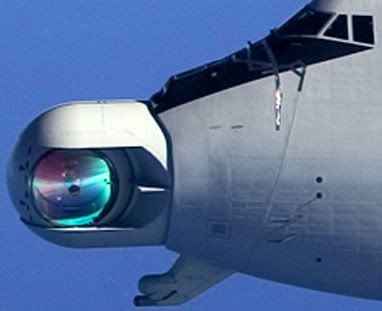
The Swift Fox features two NADIS point defense lasers mounted in retractable mounts, each capable of pumping out a 4.5 megawatts of energy.  Visually they appear very much like the airborne laser.


These systems allow the Swift Fox to engage missiles and other targets at ranges approaching 1 light second (approximately the distance between the Earth and the Moon).  However their power-output is low enough that it's unable to penetrate the standard plasma-shields that all ships in this universe come equipped with as standard.

"Plasma Shields?"


Yep! One of the greatest dangers to people in space is cosmic radiation, and since the most common conventional solution to the problem requires really dense and heavy shielding from stuff like lead, we need to go with an alternative.  Enter plasma.

The Swift Fox produces a cold plasma shield which is magnetically contained around it's hull.  This shield is charged and tuned to deflect cosmic radiation, as well as scatter the beam of incoming laser shots.  A laser that's beam is scattered by the shield is basically reduced to a really strong flashlight.

So, how does the Swift Fox bring the pain to its enemies?

Offensive Systems:

I wanted to give the Swift Fox a multipurpose/multi-mode weapon.  Enter the Electromagnetic Particle Blaster or EPB.  The EPB system uses magnetic containment and acceleration and uses three main modes of fire.

The first mode, colloquially known as dry fire acts almost identically to a conventional electromagnetic coil-gun or railgun.  The slug, usually made up of a magnetic metal is accelerated out the gun at high velocity and all the damage dealt by the kinetic energy of the impact.  It's also possible to fire canister and flak slugs from the weapon in this mode.

The second mode, known as gauss-fusion or 'wet fire' uses a very small injection of antimatter into the firing chamber.  The heat generated from the annihilation of the antimatter is used to turn the slug mass into a viscous blob of molten metal.  When fired this shot rapidly begins to expand and cool, resulting in a spray of metal akin to a shotgun blast.  Damage is inflicted both by kinetic energy and thermal effects from the super-heated spray, which can be exceptional effective against ships whose armor is made of materials susceptible to thermal effects, however it's range is again limited.

The third mode, known as 'blaster' mode is rarely used.  Instead of a small injection of antimatter, the weapon's chamber is bombarded with positrons.  The immense heat from the bombardment turns the slug mass into plasma and then excited subatomic particles as it removes all the electrons from the resulting beam of particles that's fired. When shot, the bolt rapidly begins to expand making the weapon useless at longer ranges.  The wide beam of excited particles that impacts the target has little in the way of penetration, but even then can be devastating against less protected components like radiator arrays, optics, sensors, and even burning through welds and structural weak-points. However, this mode has a track record of causing the firing chamber's containment system to fail, resulting in a powerful explosion.

The Swift Fox is equipped with two such weapons, one is a large boresight mounted device, while the second is a smaller dorsal turret system.

Next week I'll talk a bit about power systems and hull design.
Friday, April 12, 2013

Friday Food for Thought #5

Warfare in Science Fiction
Month 5, Week 2, Episode #5


 This post is a by product of a combination of world design and work I've been putting into the Ambrose Chronicles series.  It deals with the use of high technology in science fiction conflicts and deals directly with what is, in my view, most likely and realistic.  Keep in mind, that this is my opinion based in part on research and a number of thought experiments.  Take it for what it is, and be happy to disagree.

The reality of Directed Energy Weapons

In any sufficiently advanced science fiction setting, almost inevitably there will be the appearance of directed energy weapons. The form in which these occur is almost invariably divided into three separate categories: Plasma Weapons, Particle Beams, and Lasers.

Ironically, two of these really aren't so much directed energy weapons as a rather unusual form of kinetic energy weapon or thermal weapon, and one of them has been labeled by the vast majority of science fiction commentators as the 'trope that won't go away'.

So, first off... Plasma Weapons.

The idea, seems simple at first. A weapon that hurls an immensely hot body of material at a target... some form of matter that has been superheated to the point that it has gone through solid, to liquid, to gas, and ultimately been ionized and superheated into plasma.  Note: there are cold plasmas but they really are not suitable for weaponry.  The bolt, lance, or whatever form of plasma strikes the target, transferring its thermal energy into the target causing immense damage through either thermal effects or chemical reaction with the plasma material (A blast of oxygen superheated to a plasma will result in oxidation effects for example... you know, rust and fire.)

It sounds good in theory, but then a lot of things sound good in theory.  There are however a number of problems.

1.) Superheated gases expand.
2.) Ionized plasma carries a electrical charge that causes further expansion.
3.) Cold plasma has no value as a weapon system.

Ergo... Any plasma weapon fired in space will have horrifically poor range, as by the time the bolt or whatever hits the target it will have expanded a great deal by the time it hits.  As penetration by vaporization is a function of energy per area, plasma weapons won't penetrate armor that well.  However...

Imagine this... a plasma bolt strikes the craft causing say 10mm of steel to vaporize across a 30-40 meter area.  If there's a seal, a seam, or other structural weakness in the area... it would cause that seal to fail resulting in a hull breach.  If it strikes a radiator panel, it'll destroy it outright.

So... plasma could be viable as an extreme short range weapon system.  In the Ambrose Chronicles, the largest classes of ships are fitted with a forward firing antimatter-beam core drive thruster, which is used almost like an extremely short range plasma cutter that emits a beam several dozen meters thick.  As some much wiser people then I put it... any propulsion system powerful enough to be interesting, is powerful enough to use as a weapon system.  

Some weapons systems in the Ambrose Chronicles use plasma as one mode of fire, the Electromagnetic Particle Blaster for example has a fire mode where the lead of a railgun bolt is converted to plasma before firing by an antimatter discharge.  As you might imagine, there are significant dangers with breach or containment failure with such weapons.
 
Unfortunately there are other problems with Plasma weapons that make them something that would never really be useable for infantry in atmosphere.

For one... atmospheric effects turn that beam of plasma into something far less useful... a blowtorch, as most plasmas lack the density to push aside the air they're impacting when fired in an atmosphere.  Now, if they're in 5 meters or so, the weapon might be useable, but beyond that... no chance in hell.  Plus, there's the issue of carrying all the gas you're turning into plasma when you pull the trigger.

Particle Beams - Kinetic Energy Weapons that are Energy Weapons

While most authors list these as Energy Weapons, I have to admit something.  They're not.  The idea behind the particle beam is essentially the same as that behind the old cathode ray tube on those old boxy televisions you see in movies from the 1990s or earlier.  Essentially, the particle beam fires a stream of particles at extremely high speeds (sometimes just short of the speed of light).  The beam can be diffused by electrical charges or thermal interactions between the fired particles, but it's destructive power comes from the kinetic energy of the particles impacting at an immensely high speed.

Impact Energy = (Mass*Velocity^2)/2

This means that the higher density the particle or the higher velocity the weapon, the more energy is delivered on impact.  Note, this is kinetic energy and will likely be converted to thermal energy during the impact effects.  Unfortunately, as counter-intuitive as it is... Particle beams will likely have very poor penetrating power.

One of the factors in the traditional newtonian rough guide for penetration is the length of the penetrator.  Well, the penetrator for a particle beam is the length of a particle, in short it's extremely small.  As a result, all the penetration power will be due to the vaporization and blast effects from the conversion of kinetic energy to thermal energy on impact.

As a result, projectile weapons like railguns, gauss guns, coilguns, and good old chemically propelled projectiles (you know... current technology guns) will be able to penetrate better through armor then particle beams.

Particle beams also suffer from atmospheric distortion greater then what would be present with conventional lasers, making them less useable planet-side then in space.  For anything that requires penetrating power, projectile guns perform better.  For anything requiring greater accuracy or range, lasers perform better.

What do I mean by accuracy and range?  Well consider this.

The maximum effective range of aimed rifle fire is around 400 meters.  The nominal effective range tends to be around 100 meters... why?

A modern assault rifle takes around 1/10th of a second to travel 100 meters.  A human in peak physical form can move up to 13 meters in a second.

At any distance beyond 100 meters, an alert soldier can literally dodge a bullet by moving in a zig-zag fashion.  A similar thing is true for space combat.  Consider... You have a 100 meter spacecraft that can accelerate at 10 m/sec in any direction. In 10 seconds it can move a ship's length in any direction, meaning that an effective aimed shot must reach the target in under 10 seconds.

For a laser, this means an effective range equal to 3,000,000 km, that's roughly 10x the distance between the Earth and the Moon! However, lasers are hideously inefficient weapons resulting in them generating more heat internally then delivering to the target.

Particle beams travel at lower velocities (perhaps 50% of the speed of light) but are more energy efficient then lasers, but again... they don't deliver much damage for their power requirements.  They lack the penetrating power to punch through armored hulls and don't deliver as much destructive potential as other kinetic energy weapons or even plasma weapons.

This of course leaves... Lasers themselves.

Ironically, Lasers are probably the most viable weapon for certain roles in warfare as it's performance is ideal for certain uses, despite its dramatic drawbacks.  Surprisingly, its the laser which I believe to be the lone directed energy weapon to be viable as a personal weapon for a number of reasons.

The utility of lasers on spacecraft can be summed up as follows.

1.) Maximum theoretical Effective Range (thanks to the speed of light)
2.) Precision
3.) Rate of fire

Consider, a laser has no ammunition to load, it's optical report or flash isn't visible until you're hit, and it's utility in precision strikes thanks to it's range and accuracy are undeniable.  Unfortunately it's also easily defeated by armor and shielding... When you've developed ceramic tiles to defeat reentry, it's not that big of a jump to modify the tech to defeat the thermal effects of a high energy laser.  Also, magnetically contained cold plasma could be configured to act as a sort of shield for a spacecraft resulting in the laser beam being absorbed or scattered by the plasma shields, shielding ships much like how atmospheres shield planets.

Plasma shields, incidentally have many other uses for spaceflight which I'll discuss laser.

What is a space-borne laser good for? It is the perfect point defense weapon... it is great for killing enemy missiles and other projectile weapons, blowing them apart from a distance.  Nuclear or antimatter tipped missiles would be useless when destroyed at a distance, and both would be very fragile and easy for a relatively low powered laser to defeat.

I mentioned earlier that I believe it is the laser, that alone has a role as a personal weapon among the various directed energy weapons I discussed.  Surprisingly it is in part it's very drawbacks that make it ideal for that particular military role.

It is a dirty secret of the military that small arms are not legally designed to be high lethality weapons.  The typical full-metal-jacket or FMJ round is designed primarily to wound, not kill.  This is in part because the Geneva convention has a ban on more lethal 'expanding' ammunition like the hollow point projectile typically used by police and hunters.  This is also in part because of one of the other dirty secrets of warfare.

It costs an enemy more resources to take care of a wounded soldier then it looses when a soldier dies.  As one author put it, wounding a man removes three people from the firing line: the wounded soldier and his two buddies that have to carry him back to the aid station.  Killing a man removes just one.

As a result, the ideal personal weapon for warfare is not a high lethality death ray, but a weapon that causes instantaneous incapacitation and leaves a wound that requires a maximum amount of resources to treat.

The laser is a surprisingly low-lethality weapon, be it pulse or beam weapons.  This is because the only parts of the human body that can cause near instantaneous death on injury are protected under several inches of muscle and sinew.  With conventional guns, a shot to the heart, severing of the spine, or shot through the brain are the most likely causes of immediate death. A shot to other parts of the body can cause a man to bleed out and expire, but in most circumstances (unless there is a very large wound cavity) will not result in instantaneous incapacitation, and most of the time the wounded soldier will be able to function normally for as long as two minutes... or longer.

A laser has no kinetic energy besides photon pressure, this means that it does not penetrate very deep into the body on impact... as a side effect, head shots with a laser actually will likely be stopped by the skull itself, something only the weakest of conventional rounds will be stopped by.  Instead, the laser will flash boil the water and blood of the target along with vaporizing the organic compounds near the impact point, resulting in a fiery blast and an effect akin to a steam explosion on the surface of the target.

Unlike a gunshot where most of the damage occurs inside away from the majority of pain receptors, a laser wound would be focused on the exterior of the body, where the vast majority of pain receptors lie... Moreover, secondary steam burns from the impact will also hinder the target.  The blast will likely result in a crater like wound surrounded by jagged flesh that would bleed rapidly.

So, it's not instantly lethal, but... it's immensely more painful and more likely to incapacitate the target as a result.  It wounds badly enough to require immediate treatment but rarely kills.  This makes it ideal for use as a small arm.

And it gets better, if anyone is familiar with the corner-shot and the future warrior systems, you know that in urban environments there is often times a lot of problems derived from being unable to shoot around corners.  The corner-shot system is one answer, but... consider the laser.

There is no reason that the optics of a laser can't be designed to do two things.  1.) Act as a reflex sight or viewfinder if you will.  2.) Be mounted in a small ball turret and fire around corners.

Now, you could combine this with other technologies... Iris movement tracking could be used in conjunction with heads up displays to aim and fire the weapon at what it is being looked at, no aiming required, which would be really useful in close combat situations.

The speed of light also allows lasers to have an effective range greater then that of any projectile weapon.  On the ground, if you can see it, you can kill.  This means that a laser with a variable focal length and adaptive optics (the only one that really makes sense as fixed focus lasers have huge power drops when you move the target outside the focus range), would have a maximum range equal to the horizon (normally around 16,000 meters).

Now, human error would mean that actual range would more likely lie around 1,000 meters... but could be increased by sighting equipment and optical scopes.  There would be power fall off thanks to atmospheric effects, but the amount would be a great deal less than that you'd see with other directed energy weapons.

Of course... there is one problem.  Armor protection would probably exist that could defend against laser fire... but then, it'd probably be fitted in a manner similar to modern ballistic vests, so there would be weak points.  Plus, even if the blast didn't penetrate the armor, it might have set some of your clothes on fire.

If you want to defeat armor... well, you need to go back to kinetic weapons.  Of course, us writers need to know things like... what does a laser impact look like?


Well, we actually know... this video comes from a test of a ship-based laser system.  As you can see, there is flames and so forth from the impact sight, but you can also see one of the major drawbacks of lasers.

Dwell time... this is the time it takes for a laser to burn through the target.  Higher energy lasers require less dwell time as would using pulses of light with a higher energy output, but dwell time would require quite a bit to overcome completely.

The reality of Kinetic Energy Weapons

 
In theory, kinetic energy weapons are the easiest to understand... Gauss guns and railguns work basically like modern guns but with greater muzzle velocities.  However, in the space-borne environment a number of huge problems quickly are brought to the forefront, and many of the conventional thoughts on calculating range have to be thrown out.

Consider... most railgun and gauss gun designs I've heard of only have a muzzle velocity of around 2-10 km/sec.  This sounds really quite good, until you realize that low earth orbital speeds tend to be around 8.2-6.5 km/s.  Two ships closing on each other in low-earth orbit could easily have a combined closure speed of 16 km/sec, when compared to the 2-10 km/sec muzzle velocity you realize that even railguns have a lot of trouble catching spacecraft.  These speeds have huge effects on effective firing range.

A pair of spacecraft with zero relative velocity engage each other with 7 km/sec railguns.  The ships can accelerate one ship length in any direction in 10 seconds.   With this scenario the effective firing range ends up being around 70 km.

Change it to a closure rate of 14 km/sec with 7 km/sec railguns and that rang explodes to a whopping 210 km.  Speed is everything in space.

Of course... comparing the effective range with that of a laser in either circumstances show that lasers have mind boggling better reach in space combat (3,000,000 km compared to 70-210 km!).

I know, I know... what about terminal guidance systems? Can you increase that effective range.  Sure... but, we're talking about space.  It's not like ground combat where a set of thins can direct a shell with GPS.  There's no air to use to guide the shell, so any railgun shot with terminal guidance has to have an engine or thruster of some sort, and the bigger the thruster the lower the muzzle velocity and so forth.  Plus, the thruster will have to overcome the inertia from it's initial firing to vector onto a target.  As a result, terminal guidance isn't really that useful except for extreme long range shots against stationary targets (space elevators for example).

There are other possibilities... but most of them are basically firing various types of warheads.  Flak shells and canister shells so that missing might still yield damage and so forth, but doing that reduces armor penetration.

A quick word on armor penetration.  Most people don't get the physics of an impact against armor... as there are usually two separate effects at work... one of which can be roughly guessed at by the newtonian model of depth penetration, and the other can be calculated by the impact energy.  The problem is, that one works better at lower velocities and another works better at higher velocities, why?

Well at low velocities, shells penetrate by pushing their way through the impacted material, the depth of penetration is determined by the length of the penetrator (hence the more and more common appearance of 'long rod' kinetic energy shells for tank cannons), density of the penetrator, and density of the armor in Newton's rough formula.


At higher velocities, the impact energy exceeds the vaporization energy of the impactor, resulting in a 'mushrooming' effect and penetration coming more from the vaporization of armor then actually 'penetrating' it.  Ironically the point at which these two models seem to collide is around 2 km/sec in most of my estimates meaning that the modern tank round sits right where the effects are the muddiest and most contridicting between the models.

'Mushrooming' results in a blast on the opposite side of the armor much like an explosion, but has shredded the penetrator to the point that it can not proceed into subsequent compartments, but can rip through more initial armor.

So, against heavily armored ships higher velocity long rods will perform best.  Against lightly armor ships, heavier slower projectiles are more likely to tear through multiple compartments and thereby put more of a ship out of action.

There are so many tradeoffs it's mind boggling at times.

Of course, there are other possible ways to greatly increase the effectiveness of railguns.  While chemical energy HEAT rounds wouldn't be that much of an improvement, the impact energy is sufficient to cause a nuclear reaction. So firing a weapons grade uranium slug at the target could result in a nuclear reaction on impact from the compression and vaporization of the penetrator rod.  Another option would be to fire a containment vessel of antimatter, but I'd be very hesitant to hurl a containment vessel of anitmatter out of a railgun's muzzle. What if containment failed on firing?


Ouch.

The Reality of Missile Weapons

I personally divide missile weapons for space combat in science fiction into three separate categories.  Rockets, Missiles, and Torpedoes.  Each has a specific profile and utility in combat, as well as weaknesses.

Rockets use a single stage chemical motor, and are usually given a relatively simple guidance system and thrust vectoring. They'd be very similar to the 'micro-missile' concept you see in a lot of anime series. 

Ironically, a little research reveals that for simple and shorter range missile weapons there is no reason not to use chemical rocket motors as they provide a huge amount of thrust for a very short period of time.  This means that for short ranges, chemical motors are ideal.

The lack of atmosphere greatly decreases the effective range of a missile, as most missiles use the atmosphere to vector themselves onto their target after their motor has burnt out, and most missile's use rocket motors that burn out long before they reach the actual target.

In space there is no air to use to vector the rocket, so the moment the motor burns out they're on a ballistic course, greatly reducing the effective range of the weapon against a maneuvering opponent.

Effective range can be increased by using either submunitions with their own propulsion or a second stage.  These weapons are what I tend to refer to as missiles, as they are longer range then rockets.  The idea being that the missile gets in the rough area of the target on the first rocket motor, when a second motor engages to rocket the warhead into the target.

Again, range is relatively limited as the further away the target, the more time the target has to maneuver clear.

The third type is the torpedo... instead of chemical rockets torpedoes use propulsion systems much like larger ships, as essentially they operate as kamikaze ships, if you will.  They have the greatest range and payload.

All missile weapons are vulnerable to point defenses like lasers, and likely would have to be volley or salvo fired to be effective. It's possible that the heaviest missiles and torpedoes could feature some form of armor against lasers to increase the chance that they could deliver their payload.

As for payloads... most ships travel faster then the gas expansion rate of conventional explosives.  Damage instead is likely to result from kinetic energy payloads, nuclear payloads, or matter-antimatter reactions (I do like them, but making antimatter is a real challenge so those would be very expensive warheads).  Kinetic energy payloads could amount to something as simple as the missile's body being made of hardened steel, or a canister filled with ball-bearings.  Nuclear payloads are self evident, but the effectiveness of nuclear arms is degraded by the lack of blast effects... though if you get the missile within 1/2 a kilometer, it likely doesn't matter as thermal effects alone could cause immense damage.  Others have posited the idea of using a nuclear warhead to power a single shot laser, but I'm not sure that would be a great solution.

Antimatter-warheads likely would be about as effective as nuclear ones, albeit with a higher yield.


Putting it all together...
A great deal of space combat is dependent on defenses as well as weapons systems.  Any ship is likely to use compartmentalization, and as whipple armor is practically standard for space craft right now (as a defense against micrometeorites), we can expect those two features to be definite parts of ship design in the future.

Other bits are much less definite... how much power will ships have, how effecient will they be? Will ships have limited G-loads or inertial compensation?  What defenses will they have against radiation, heat, or other effects?

All of that is important, but with just the weapons listed I can give you this basic idea of combat in space.

Ships will be identified long before they're in firing range, as there is no stealth in space.  Optical identification could well be done at millions of kilometers, and spectral readings of engine exhaust would be enough to identify a number of features of a ship.

Say two ships close to engage each other, at extreme ranges they begin to fire their laser weapons, aiming to harass the enemy as ships would likely be armored against laser fire, and dwell time can be sidestepped by maneuvering the ship.

The ships continue to close and both fire torpedoes, the lasers switch their fire to the torpedoes likely destroying them... if they fail to, one ship badly damages the other with the torpedoes.

The ships continue to close and fire any missiles they have, again the lasers switch their fire to intercept the missiles, one or more is more likely to penetrate the laser's point defense screen to cause some damage.

The ships enter effective projectile fire range (perhaps 500 kilometers or less) and open fire with batteries of railguns, coilguns, and other projectile weapons.  Both ships inflict damage and continue to hurtle toward each other.

The ships enter rocket range, firing salvos of dozens of single engine rockets as they hurtle toward each other and then pass each other at ranges of less than 50 kilometers.  If plasma weapons exist, they are fired at this point.

The two ships hurtle out to longer ranges, damaged by the pass and turn back to face each other again, then begin another pass until one ship disengages or is incapable of continuing and tumbles away on a ballistic course.

In some ways its almost like old naval fleet engagements... the lasers are used like chaser guns, while all the weapons firing during a pass is akin to a volley or broadside, but boarding isn't really a valid option.

Escape is relatively easy so long as one ship's acceleration potential is roughly the same as another, they simply keep going after a pass.

Sunday, March 31, 2013

Ambrose Chronicles #1


Now, I spent some time doing math for this... as Ambrose Chronicles is supposed to be a relatively 'Hard' Science Fiction series, so here is something for the more technically minded of you to chew on.  The ship that is the main ship in the series thus far.

Peregrine-class Gunboat Swift Fox 

GENERAL
 
·         Type:                      Gunboat (GB)

·         Length:                  82.1 meters

·         Width:                   45.2 meters

·         Height:                   12.1 meters

·         Mass:                      3,700,000 kg

PERFORMANCE

·         Acceleration:        15.51 G (20.01 G with Afterburner)

·         Max Velocity:       3,520 km/sec (1.17%c)

·         Powerplant:          2.75µg/s White-Rinmukan AM-M Reactor

o    Power Output:                    400 megawatts

·         Propulsion:           2x 32.5AGS White-Rinmukan Plasma Core Drives

o    General

§  Type:                      Antimatter Plasma Core Drive

§  Features:               Deuterium Fusion Afterburner

§  Length:                  72.53 meters

§  Diameter:              10.36 meters

§  Mass:                     536,000 kilograms

o    Components:

§  Containment:        3x 6.14 MW Rinmukan EMC Coils

§  Fuel Injector:        1x 26.0 µg/s Antimatter Injector

§  Mass Injector:       3x 70MGS Deuterium Oxide Injectors

§  Nozzles:               3x Magnetic Deflection Baffles

o    Performance:

§  Thrust Output:       281 MN of thrust each

§  Fuel Use:               32.5 ag/s of Antimatter

§  Reactant Use:        210 mg/s of D2O

COMPLIMENT

·         Crew:                     20 (5 officers, 15 enlisted)

·         Decks:                    2 ½

DEFENSES

·         Compressed Reinforced Carbon-Carbon Nanofiber Hull

o    Density:                               3.52 g/cm3

o    Max Temperature:              +3,900 degrees Celsius

o    Structural Strength:            1,350 MPa

·         Magnetically Contained Plasma Shields

·         Whipple Ablative Plating

AVIONICS 
    Spectral Sensors
    3x Radar Arrays

CURRENT ARMAMENT

·         1x Imperial Armstrong Industries EPB 50-kilo Mark I Cannon

·         1x Imperial Armstrong Industries EPB 18-kilo Mark I Cannon

·         2x 4.5MW NADIS Military Systems Point Defense Lasers

Conceived as a set of guns with engines attached, the Peregrine-class is a fast moving gunboat designed to engage smaller ships in pitched combat.  Designed in 2056 AY, the class is nearing the end of its service life.  Most examples have undergone a number of revisions and modifications, most notably the replacement of the class’s original armament with the then experimental EPB Cannons.

Most ships were subsequently retired after the various faults in the EPB cannons were discovered, but a number remain in use thanks to their utility as courier ships and still competitive performance.

Looking for Beta Readers

Happy Easter everyone!

Now, it's hard to believe that in all my years, I really haven't had much in the way of what are known as 'Beta' readers or even 'Alpha' readers if you will, so...

This is an open call for Alpha and Beta Readers, if you wish to take part send me an e-mail at stellarmagic01@gmail.com

Now, to explain what exactly an Alpha or Beta reader is, at least to me, is to put it this way. When someone first starts making much of anything... They usually need someone behind them to cheer them on.  This is the primary job of an Alpha Reader, to demand the next chapter and force me to write it.  Right now my focus is on Original Fiction, so if you want to volunteer for a Fanfiction Alpha or Beta reading position, just wait until I have one available to you.

A Beta Reader is someone who does more than demand the next chapter, a beta reader helps a writer iron out mistakes, call out problems, and effectively... acts to critique what I write in the hope of improving it.

I should say that you really should only volunteer to be an Alpha if you're able to deal with very rough works... Anyway. Here are the positions I'm looking for.

Alpha Reader and Beta Reader for the Ambrose Chronicles, a Science Fiction/YA.
Alpha Reader and Beta Reader for the Fox's Tale series, a Fantasy/YA.

Details about these stories can be found on my 'Projects' Page.

Once again, this is an open call for Alpha and Beta Readers, if you wish to take part send me an e-mail at stellarmagic01@gmail.com