Ebola in the United States
Well, I was going to talk about science-fiction ship design, but then this issue exploded this week and well... I already talked about Ebola a bit before, so I should probably say something. Let’s start with the facts:
A Liberian man who was working toward gaining legal residency status in the United States arrived on September 20th, 2014. On September 24th he fell ill and went to the hospital on the 26th where he was diagnosed with a viral infection and released despite being from an Ebola outbreak zone. He was taken to the hospital a second time on September 28th by ambulance and is current undergoing care in a hospital in Dallas.
He was staying with his apparent girlfriend in an apartment, along with several children. Currently the family is under quarantine and over 100 people have been identified as being at risk for exposure.
This is scary, especially for those that don't understand. Considering I currently am getting my ass kicked by a cold and will almost certainly be the recipient of looks after this, I should point out that we're talking about 1 case in a country of over 300 million people at this point.
It's not the time to panic. We should certainly be concerned, especially in light of the obvious failure of the Liberian government's attempt to screen passengers and the hospital failing to diagnose the case during his first visit.
This is probably going to be only the first in several such incidents, as the West African countries that are currently being ravaged by the disease have pretty strong historical ties with the United States. In addition we should probably expect many other countries to have this occur as panic causes people to try and flee from the outbreak.
The last WHO estimates and projections I saw were horrifying, with their upper estimates putting the number of expected cases to reach as high as 1.4 million by year's end, with the number of cases increasing by over 10,000 a week by the end of October. With this rate of infection the probability of the disease reaching United States shores soars, and already a couple other possible cases have begun to crop up.
Knowing all this, and the CDC and WHO warnings about the dangers of a pandemic of other diseases, it's probably a good idea to learn about the disease and how to protect yourself from it.
Transmission:
Ebola is widely considered to be a rather difficult virus to catch, in that it is normally only transmittable through fluid contact - such as through vomit, sweat, blood, urine, saliva, and other bodily fluids. Most experts say the disease is not transmittable by air. I say most because I did run across a couple research papers which indicate that some viral particulates of Ebola can become airborne, but this mode of transmission is extremely rare and only probable in environments with a large number of patients in a confined area.
Ebola however is highly transmittable through the smallest amount of bodily fluids and aerosal. This is why health workers wear face masks and various forms of full body protection. As an individual you can reduce your risk for exposure by avoiding contact with bodily fluids, dirtied clothes, and people that generally look as if they've fallen ill. Additional protection through the use of face masks or rubber gloves will keep you safe in most circumstances, though it still will not be one hundred percent effective.
Incubation Period:
Ebola has an incubation period of 2-21 days, depending on the severity of the exposure and health of the exposed individual. Unlike some diseases, Ebola's infectiousness increases with the severity of the symptoms. The bodies of the victims of Ebola are an extremely infectious object and as a result must be burned to prevent the spread of the disease.
Symptoms:
Initial symptoms of Ebola echo that of the common flu... muscle aches, tiredness, cold sweats, and fever. As the disease worsens additional symptoms occur including vomiting, diarrhea, internal hemorrhaging, bloody stool, blood in the urine, bleeding from the eyes and nose, and ultimately death due to complications from blood loss.
Immunity:
Survivors of the disease tend to have antibodies that will last up to thirty years, though there's no documented information on if this immunity is localized to just a strain or the disease in it's entirety. Survivors remain infectious for as long as three months after they've begun their recovery, especially through sexual contact.
Showing posts with label Ebola. Show all posts
Showing posts with label Ebola. Show all posts
Friday, October 3, 2014

Friday, August 8, 2014
Friday Food For Thought #21
Why You Should be Worried about Ebola
Today, August 8th, 2014 the World Health Organization declared that the Ebola outbreak in West Africa is now a 'Public Health Emergency of International Concern'. This represents only the third time that the World Health Organization (WHO) has declared a public health emergency, with previous declarations coming from the reemergence of polio and the H1N1 virus or 'Swine Flu' pandemic.
None of these viral outbreaks comes close to the level of mortality of Ebola. From current reports, the Ebola outbreak in West Africa is of a virus with around a 55% mortality rate, which while low for Ebola (It has occasionally had mortality rates as high a 90%) is still several times worse then any pandemic virus in recent memory. The Spanish Flu, which is often considered something of a measuring stick for modern pandemics had a mortality rate of around only 10-20% of cases. This is even higher then the Black Death which had a mortality rate of 30-40% of cases.
While there are a number of limiting factors for the spread of Ebola, foremost among them being that it isn't an airborne virus, the continual infection of emergency workers (around 10% of reported cases and deaths) show that despite it being only transmittable through bodily fluids and blood, it is spreading even to those who take the greatest precautions relatively easily. This is because, Ebola is very infectious, requiring only a tiny amount of exposure to be transmitted. It also has a history of being transmittable through aerosol. Considering the speed of the outbreak's spread and the continual cases of aid workers, I'm pretty sure this strain is capable of spreading via aerosol. A cough, a sneeze, and spit therefore become transmission vectors.
 With 140 to 150 cases of Health Care workers being infected even with full-body protection (like what's shown above), one has to wonder if it's even possible to really protect doctors and nurses from the disease.
Currently the Ebola outbreak has spread to just four countries (Liberia, Sierra Leone, Guinea, and Nigeria) though the United States and Spain both have taken citizens with the virus back home for treatment. However, the situation is set to rapidly worsen as Liberia's Health Care system has officially collapsed and doctors are fleeing the country to escape the virus. As a result, Liberia's population of 4.1 million people are basically completely unprotected from the virus.
Recent news also lists suspected cases now in Benin and Uganda, increasing the number of countries affected by the disease to six. The total population of these countries is over 240+ million people, with the largest population at risk being that of Niger with around 175 million. One of these suspected cases traveled through South Sudan, so that's another country that may be at risk as well.
Scares have happened all across the globe as fears of the virus have led to incidents at airports and on borders.
The decision to bring home American and Spanish citizens who had been infected, worries me. If the disease is as easily transmittable to health care workers as it seems to be, there is a risk that those who are working at the hospitals where these people are being treated will be infected.
Ebola has a three-week incubation period before symptoms begin to appear. This means that say... someone in Liberia that has been infected decides to flee the country, it will be three weeks before their first symptoms appear. From the diseases onset to even after death (Ebola is actually at its most infectious from contact with dead bodies) he will be capable of spreading the disease. The lower then normal mortality rate of the current strain is actually making the disease spread faster, as people are living long enough to spread it to many others.
How far can a man go in three-weeks from exposure to onset? Well... Practically anywhere. Some direct flights between infected countries have been closed, but this will not insure the containment of the disease as a person could jump the border, get onto a plane in an unaffected country and fly anywhere in the world. One of the most recent cases flew through South Sudan, and there have been scares involving flights from the Middle East. Moreover, the WHO is estimating that only 25-50% of cases are being reported, making the likely total number of cases between 4-8 thousand at this point.
So far, we've actually been lucky it hasn't spread beyond West Africa, but our luck can't hold out forever and as the Liberia Health System implodes and people begin to flee the disease areas, I suspect it will get worse and fast. Thus far, Ebola has never spread beyond West Africa but if this is something that will hold true in this case?
I'd really hate to gamble on it.
Today, August 8th, 2014 the World Health Organization declared that the Ebola outbreak in West Africa is now a 'Public Health Emergency of International Concern'. This represents only the third time that the World Health Organization (WHO) has declared a public health emergency, with previous declarations coming from the reemergence of polio and the H1N1 virus or 'Swine Flu' pandemic.
None of these viral outbreaks comes close to the level of mortality of Ebola. From current reports, the Ebola outbreak in West Africa is of a virus with around a 55% mortality rate, which while low for Ebola (It has occasionally had mortality rates as high a 90%) is still several times worse then any pandemic virus in recent memory. The Spanish Flu, which is often considered something of a measuring stick for modern pandemics had a mortality rate of around only 10-20% of cases. This is even higher then the Black Death which had a mortality rate of 30-40% of cases.
While there are a number of limiting factors for the spread of Ebola, foremost among them being that it isn't an airborne virus, the continual infection of emergency workers (around 10% of reported cases and deaths) show that despite it being only transmittable through bodily fluids and blood, it is spreading even to those who take the greatest precautions relatively easily. This is because, Ebola is very infectious, requiring only a tiny amount of exposure to be transmitted. It also has a history of being transmittable through aerosol. Considering the speed of the outbreak's spread and the continual cases of aid workers, I'm pretty sure this strain is capable of spreading via aerosol. A cough, a sneeze, and spit therefore become transmission vectors.
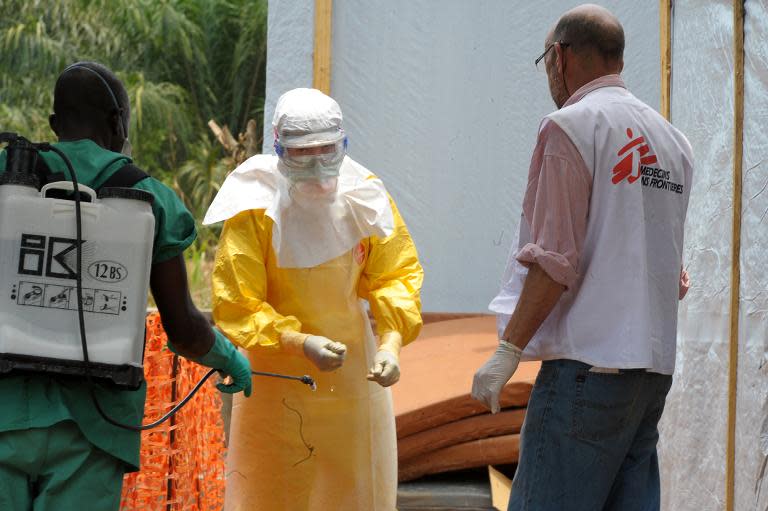
Currently the Ebola outbreak has spread to just four countries (Liberia, Sierra Leone, Guinea, and Nigeria) though the United States and Spain both have taken citizens with the virus back home for treatment. However, the situation is set to rapidly worsen as Liberia's Health Care system has officially collapsed and doctors are fleeing the country to escape the virus. As a result, Liberia's population of 4.1 million people are basically completely unprotected from the virus.
Recent news also lists suspected cases now in Benin and Uganda, increasing the number of countries affected by the disease to six. The total population of these countries is over 240+ million people, with the largest population at risk being that of Niger with around 175 million. One of these suspected cases traveled through South Sudan, so that's another country that may be at risk as well.
Scares have happened all across the globe as fears of the virus have led to incidents at airports and on borders.
The decision to bring home American and Spanish citizens who had been infected, worries me. If the disease is as easily transmittable to health care workers as it seems to be, there is a risk that those who are working at the hospitals where these people are being treated will be infected.
Ebola has a three-week incubation period before symptoms begin to appear. This means that say... someone in Liberia that has been infected decides to flee the country, it will be three weeks before their first symptoms appear. From the diseases onset to even after death (Ebola is actually at its most infectious from contact with dead bodies) he will be capable of spreading the disease. The lower then normal mortality rate of the current strain is actually making the disease spread faster, as people are living long enough to spread it to many others.
How far can a man go in three-weeks from exposure to onset? Well... Practically anywhere. Some direct flights between infected countries have been closed, but this will not insure the containment of the disease as a person could jump the border, get onto a plane in an unaffected country and fly anywhere in the world. One of the most recent cases flew through South Sudan, and there have been scares involving flights from the Middle East. Moreover, the WHO is estimating that only 25-50% of cases are being reported, making the likely total number of cases between 4-8 thousand at this point.
So far, we've actually been lucky it hasn't spread beyond West Africa, but our luck can't hold out forever and as the Liberia Health System implodes and people begin to flee the disease areas, I suspect it will get worse and fast. Thus far, Ebola has never spread beyond West Africa but if this is something that will hold true in this case?
I'd really hate to gamble on it.
Subscribe to:
Posts (Atom)